Meaning Of Lame Excuse. A shiny fabric woven with metallic threads, often of gold or silver. Lame excuse word meaning in english is well described here in english as well as in urdu.
Meaning Of Lame Adriandsx from adriandsx.blogspot.com The Problems With Real-Time Theories on Meaning
The relationship between a symbol as well as its significance is known as"the theory or meaning of a sign. We will discuss this in the following article. we'll be discussing the problems with truth conditional theories of meaning, Grice's study of speaker-meaning and The semantics of Truth proposed by Tarski. We will also consider theories that contradict Tarski's theory about truth.
Arguments against the truth-based theories of significance
Truth-conditional theories of meaning assert that meaning is the result of the elements of truth. However, this theory limits the meaning of linguistic phenomena to. The argument of Davidson is the truth of values is not always truthful. So, it is essential to be able to discern between truth-values and a flat statement.
The Epistemic Determination Argument is a way to prove the truthfulness of theories of meaning. It is based upon two basic theories: omniscience regarding non-linguistic facts and knowing the truth-condition. However, Daniel Cohnitz has argued against these assumptions. This argument therefore doesn't have merit.
Another major concern associated with these theories is the lack of a sense of meaning. However, this issue is addressed through mentalist analysis. In this method, meaning can be examined in regards to a representation of the mental, rather than the intended meaning. For example that a person may find different meanings to the one word when the person is using the same words in both contexts, but the meanings behind those words can be the same regardless of whether the speaker is using the same phrase in multiple contexts.
Although most theories of meaning attempt to explain what is meant in regards to mental substance, non-mentalist theories are occasionally pursued. This is likely due to suspicion of mentalist theories. They can also be pushed in the minds of those who think mental representations must be evaluated in terms of linguistic representation.
Another key advocate of this position The most important defender is Robert Brandom. This philosopher believes that significance of a sentence derived from its social context and that the speech actions comprised of a sentence can be considered appropriate in any context in which they are used. He has therefore developed a pragmatics concept to explain the meaning of sentences using normative and social practices.
Problems with Grice's analysis of speaker-meaning
Grice's analysis based on speaker-meaning puts major emphasis upon the speaker's intention and how it relates to the meaning and meaning. The author argues that intent is an abstract mental state that must be considered in order to grasp the meaning of sentences. Yet, this analysis violates speaker centrism through analyzing U-meaning without M-intentions. Furthermore, Grice fails to account for the reality that M-intentions can be specific to one or two.
Further, Grice's study doesn't take into consideration some significant instances of intuitive communication. For instance, in the photograph example of earlier, the individual speaking isn't clear as to whether he was referring to Bob himself or his wife. This is a problem because Andy's photo doesn't reveal whether Bob is faithful or if his wife is unfaithful , or loyal.
While Grice believes the speaker's meaning is more fundamental than sentence-meaning, there's some debate to be had. The distinction is essential to the naturalistic credibility of non-natural meaning. Grice's objective is to offer naturalistic explanations for such non-natural meaning.
To comprehend a communication one must comprehend the speaker's intention, as that intention is complex in its embedding of intentions and beliefs. However, we seldom make complex inferences about mental states in everyday conversations. Therefore, Grice's model on speaker-meaning is not in line with the actual processes involved in understanding of language.
While Grice's explanation of speaker meaning is a plausible explanation of this process it's not complete. Others, such as Bennett, Loar, and Schiffer have come up with more thorough explanations. These explanations have a tendency to reduce the validity of the Gricean theory, as they view communication as an unintended activity. In essence, audiences are conditioned to think that the speaker's intentions are valid because they perceive what the speaker is trying to convey.
It does not provide a comprehensive account of all types of speech acts. Grice's approach fails to take into account the fact that speech acts can be used to clarify the meaning of sentences. In the end, the content of a statement is reduced to what the speaker is saying about it.
Problems with Tarski's semantic theory of truth
While Tarski believes that sentences are truth-bearing but this doesn't mean any sentence is always correct. Instead, he attempted to define what is "true" in a specific context. His theory has become an integral part of modern logic, and is classified as deflationary theory, also known as correspondence theory.
One of the problems with the theory for truth is it can't be applied to any natural language. This issue is caused by Tarski's undefinability concept, which asserts that no bivalent languages has the ability to contain its own truth predicate. Even though English might seem to be an an exception to this rule and this may be the case, it does not contradict with Tarski's stance that natural languages are closed semantically.
But, Tarski leaves many implicit constraints on his theory. For example, a theory must not include false sentences or instances of form T. In other words, theories should not create being a victim of the Liar paradox. Another problem with Tarski's theories is that it isn't compatible with the work of traditional philosophers. In addition, it's impossible to explain every single instance of truth in terms of ordinary sense. This is a major challenge for any theory on truth.
Another problem is the fact that Tarski's definitions of truth demands the use of concepts that come from set theory and syntax. These are not appropriate when considering endless languages. Henkin's style of language is well-established, but it doesn't match Tarski's concept of truth.
It is also controversial because it fails make sense of the complexity of the truth. Truth, for instance, cannot play the role of predicate in the interpretation theories, and Tarski's theories of axioms can't explain the semantics of primitives. Additionally, his definition of truth is not compatible with the notion of truth in theory of meaning.
However, these challenges will not prevent Tarski from applying an understanding of truth that he has developed and it is not a qualify as satisfying. In fact, the true definition of truth may not be as precise and is dependent upon the particularities of the object language. If you're interested in learning more, take a look at Thoralf Skolem's 1919 article.
The problems with Grice's approach to sentence-meaning
The problems with Grice's understanding of the meaning of sentences can be summarized in two main areas. First, the purpose of the speaker should be recognized. Second, the speaker's utterance must be supported by evidence that demonstrates the desired effect. However, these criteria aren't satisfied in every instance.
This issue can be resolved by changing Grice's understanding of phrase-based meaning, which includes the meaning of sentences that do not have intentionality. This analysis is also based on the premise that sentences can be described as complex and have several basic elements. So, the Gricean analysis doesn't capture examples that are counterexamples.
This assertion is particularly problematic as it relates to Grice's distinctions of speaker-meaning and sentence-meaning. This distinction is crucial to any naturalistically respectable account of sentence-meaning. It is also necessary to the notion of implicature in conversation. It was in 1957 that Grice established a base theory of significance that the author further elaborated in subsequent articles. The fundamental concept of the concept of meaning in Grice's research is to look at the speaker's intentions in understanding what the speaker intends to convey.
Another issue with Grice's method of analysis is that it does not account for intuitive communication. For example, in Grice's example, it's not entirely clear what Andy means by saying that Bob is not faithful for his wife. But, there are numerous cases of intuitive communications that are not explained by Grice's theory.
The fundamental claim of Grice's approach is that a speaker must intend to evoke an effect in viewers. But this isn't in any way philosophically rigorous. Grice sets the cutoff according to possible cognitive capabilities of the partner and on the nature of communication.
Grice's understanding of sentence-meaning doesn't seem very convincing, though it's a plausible analysis. Other researchers have devised more detailed explanations of meaning, but they are less plausible. In addition, Grice views communication as an activity that is rational. People make decisions by understanding the speaker's intent.
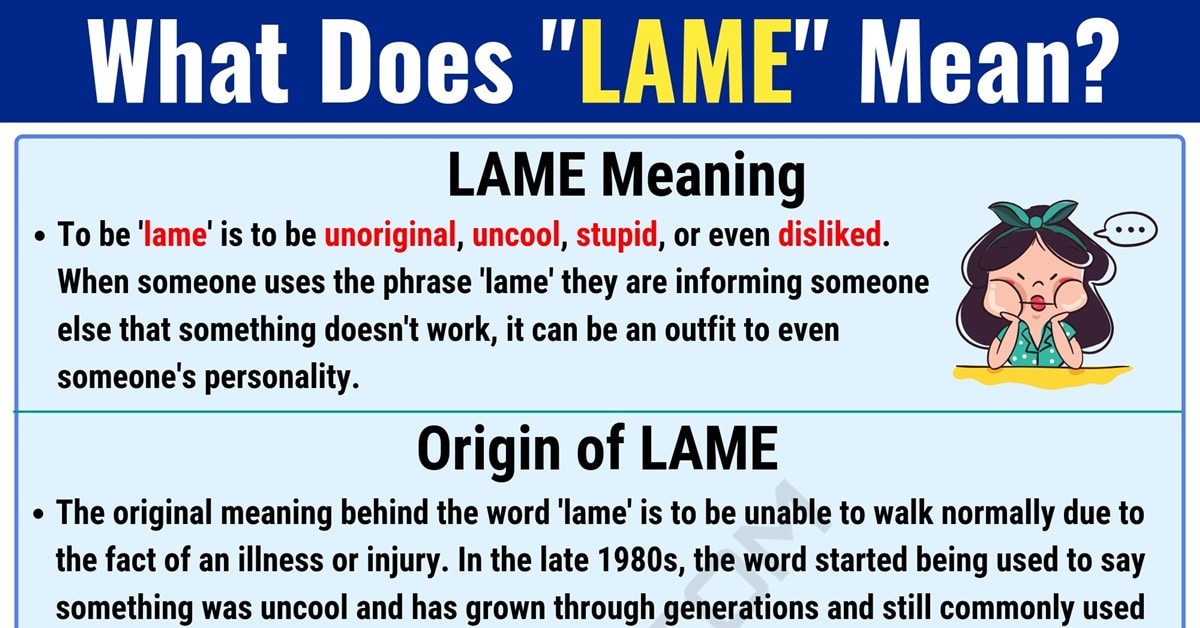
More meanings of lame excuse, it's definitions, example sentences, related words, idioms and quotations. Lame synonyms, lame pronunciation, lame translation, english dictionary definition of lame. A 'lame excuse' is an excuse of poor quality or lack of thought or an inappropriate excuse.
Sleeping Too Long Is A Lame Excuse For Being Late.
How to use lame in a sentence. For instance, a man was late for work and he had no real reason why, so. Learn and practice the pronunciation of lame excuse.
Definition Of The Lame Excuse In The Idioms Dictionary.
More meanings of lame excuse, it's definitions, example sentences, related words, idioms and quotations. A lame argument a lame duck a lame excuse a lame foot or leg. (=weak, feeble) he mumbled some lame excuse about having gone to.
(Especially Of Animals) Not Able To Walk Correctly Because Of Physical Injury To Or Weakness In….
What is the meaning of lame in slang? A shiny fabric woven with metallic threads, often of gold or silver. Spoken pronunciation of lame excuse in english and in telugu.
You Can Use This Amazing English To Urdu Dictionary Online To Check The Meaning Of Other Words.
Lame excuse an excuse or reasoning that is considered pathetically unconvincing or inadequate. A lame person a lame person, a crip ple. 12 she gave some lame.
My Lame Excuse Is That I Have Too Much To Do.
He gave a lame excuse for being absent. When i asked him why he was late, he just gave me some lame excuse about his alarm clock. Lame synonyms, lame pronunciation, lame translation, english dictionary definition of lame.

Post a Comment for "Meaning Of Lame Excuse"