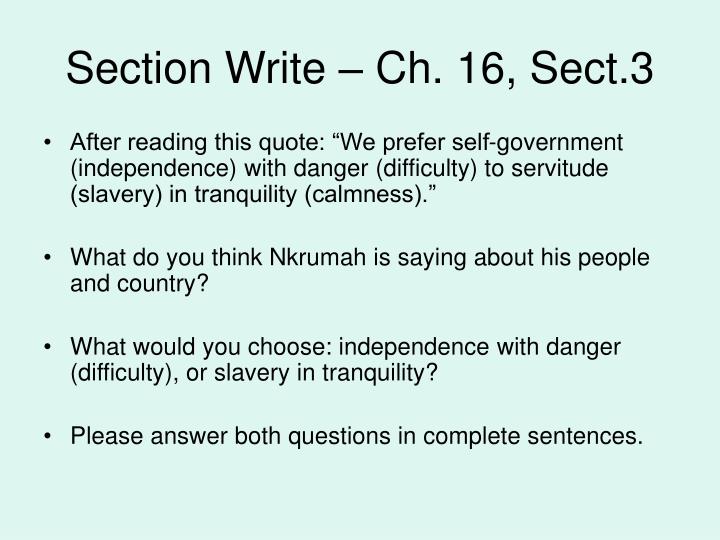
We Prefer Self-Government With Danger To Servitude In Tranquility Meaning. Lewis khalil gibran charlie chaplin gautama buddha isaac newton Axioms of kwame nkrumah (1967)
PPT Do chapter 16, section 3, Independence in Africa Outline Map (p from www.slideserve.com The Problems with the Truth Constrained Theories about Meaning
The relationship between a symbol to its intended meaning can be called"the theory or meaning of a sign. Within this post, we will discuss the problems with truth-conditional theories of meaning, Grice's examination of meaning-of-the-speaker, and that of Tarski's semantic theorem of truth. We will also analyze evidence against Tarski's theories of truth.
Arguments against truth-conditional theories of meaning
Truth-conditional theories about meaning argue that meaning is the result of the elements of truth. However, this theory limits definition to the linguistic phenomena. It is Davidson's main argument that truth-values are not always the truth. We must therefore be able to distinguish between truth-values and an claim.
Epistemic Determination Argument Epistemic Determination Argument is a method to establish truth-conditional theories for meaning. It is based on two fundamental foundational assumptions: omniscience over nonlinguistic facts as well as knowing the truth-condition. But Daniel Cohnitz has argued against these assumptions. So, his argument is unfounded.
Another problem that can be found in these theories is the implausibility of meaning. The problem is solved by mentalist analysis. In this manner, meaning can be analyzed in terms of a mental representation, rather than the intended meaning. For instance there are people who find different meanings to the exact word, if the person is using the same word in multiple contexts however, the meanings and meanings of those words may be the same when the speaker uses the same phrase in two different contexts.
Although most theories of meaning try to explain interpretation in relation to the content of mind, other theories are often pursued. This is likely due to skepticism of mentalist theories. They may also be pursued through those who feel that mental representation should be analyzed in terms of linguistic representation.
Another significant defender of the view I would like to mention Robert Brandom. He is a philosopher who believes that value of a sentence dependent on its social and cultural context and that actions with a sentence make sense in the setting in the context in which they are utilized. This is why he developed a pragmatics theory to explain sentence meanings through the use of cultural normative values and practices.
Problems with Grice's study of speaker-meaning
Grice's analysis of speaker-meaning places an emphasis on the speaker's intentions and their relation to the meaning and meaning. Grice argues that intention is an intricate mental process that needs to be understood in order to comprehend the meaning of the sentence. However, this interpretation is contrary to speaker centrism in that it analyzes U-meaning without considering M-intentions. Furthermore, Grice fails to account for the possibility that M-intentions aren't only limited to two or one.
The analysis also fails to account for some crucial instances of intuitive communication. For instance, in the photograph example in the previous paragraph, the speaker does not clarify whether she was talking about Bob and his wife. This is because Andy's photo doesn't reveal whether Bob himself or the wife is not faithful.
Although Grice is correct that speaker-meaning is more important than sentence-meaning, there's still room for debate. In fact, the distinction is crucial to the naturalistic recognition of nonnatural meaning. In reality, the aim of Grice is to present naturalistic explanations for the non-natural meaning.
To understand a message one must comprehend the meaning of the speaker and this is a complex embedding of intentions and beliefs. However, we seldom make profound inferences concerning mental states in regular exchanges of communication. Thus, Grice's theory of speaker-meaning is not compatible to the actual psychological processes that are involved in language comprehension.
Although Grice's explanation for speaker-meaning is a plausible explanation that describes the hearing process it is insufficient. Others, like Bennett, Loar, and Schiffer, have created deeper explanations. These explanations, however, can reduce the validity of the Gricean theory, because they treat communication as an act that can be rationalized. In essence, audiences are conditioned to accept what the speaker is saying since they are aware of the speaker's motives.
Additionally, it fails to cover all types of speech act. Grice's method of analysis does not recognize that speech is often employed to explain the significance of a sentence. In the end, the content of a statement is reduced to the meaning of the speaker.
Issues with Tarski's semantic theory of truth
While Tarski suggested that sentences are truth-bearing however, this doesn't mean the sentence has to always be true. Instead, he sought to define what is "true" in a specific context. The theory is now an integral part of contemporary logic and is classified as deflationary or correspondence theory.
One problem with this theory for truth is it is unable to be applied to any natural language. This issue is caused by Tarski's undefinability principle, which claims that no bivalent one can be able to contain its own predicate. Although English might appear to be an the only exception to this rule However, this isn't in conflict in Tarski's opinion that natural languages are closed semantically.
But, Tarski leaves many implicit constraints on his theory. For example the theory cannot contain false statements or instances of form T. That is, theories should avoid any Liar paradox. Another issue with Tarski's idea is that it isn't in line with the work of traditional philosophers. Additionally, it's not able to explain all cases of truth in terms of the common sense. This is a major issue to any theory of truth.
The other issue is that Tarski's definitions for truth is based on notions that come from set theory and syntax. They are not suitable for a discussion of infinite languages. Henkin's style of speaking is based on sound reasoning, however this does not align with Tarski's notion of truth.
Tarski's definition of truth is also controversial because it fails explain the complexity of the truth. In particular, truth is not able to serve as an axiom in an understanding theory, and Tarski's theories of axioms can't clarify the meanings of primitives. Furthermore, his definitions of truth does not align with the concept of truth in the theories of meaning.
However, these concerns can not stop Tarski from using the definitions of his truth and it doesn't qualify as satisfying. In actual fact, the definition of truth isn't as basic and depends on peculiarities of language objects. If you'd like to know more about the subject, then read Thoralf Skolem's 1919 article.
The problems with Grice's approach to sentence-meaning
The issues with Grice's analysis of sentence meaning can be summarized in two key points. First, the intent of the speaker has to be understood. Furthermore, the words spoken by the speaker must be supported with evidence that confirms the intended result. However, these conditions aren't fulfilled in all cases.
This issue can be fixed through changing Grice's theory of sentence interpretation to reflect the meaning of sentences that do not exhibit intention. This analysis is also based upon the assumption sentence meanings are complicated entities that contain a variety of fundamental elements. Thus, the Gricean analysis is not able to capture instances that could be counterexamples.
This is particularly problematic with regard to Grice's distinctions between speaker-meaning and sentence-meaning. This distinction is essential to any naturalistically credible account of sentence-meaning. This theory is also vital to the notion of implicature in conversation. When he was first published in the year 1957 Grice proposed a starting point for a theoretical understanding of the meaning that was further developed in subsequent works. The basic notion of significance in Grice's work is to examine the speaker's motives in determining what message the speaker intends to convey.
Another issue with Grice's theory is that it does not reflect on intuitive communication. For example, in Grice's example, it's unclear what Andy means by saying that Bob is unfaithful of his wife. There are many instances of intuitive communication that do not fit into Grice's theory.
The main claim of Grice's model is that a speaker must aim to provoke an emotion in people. This isn't in any way philosophically rigorous. Grice fixes the cutoff point using potential cognitive capacities of the contactor and also the nature communication.
Grice's analysis of sentence-meaning cannot be considered to be credible, though it's a plausible theory. Other researchers have come up with more elaborate explanations of significance, but these are less plausible. Additionally, Grice views communication as a rational activity. Audiences reason to their beliefs by recognizing communication's purpose.
The industrial revolution pushed the world into modern industrialization. Axioms of kwame nkrumah (1967) It changed the course of history profoundly.
Danger Government Quiet Self Servitude Tranquility Popular Authors Marilyn Monroe Paulo Coelho Abraham Lincoln C.
It caused rapid urbanization and pushed cities and countries. Today we have access to highly advanced technologies. Natural abilities are like natural plants, that need pruning by study and studies themselves do give forth directions too much at large, except they be bounded in by experience.
This Quote Is About Government, Danger, Servitude, Tranquility, Quiet,.
“it is far better to be free to govern or misgovern yourself than to be governed by anybody else” The industrial revolution pushed the world into modern industrialization. To live is to suffer, to survive is to find.
When Someone Shows You Who They Are, Believe Them The First Time.
If you have never heard or seen them, visit. To all the congress small figs, congress boys and girls, the words 'servitude in tranquillity' were spoken and written by é”sagyefo. Axioms of kwame nkrumah (1967)
But Our Social And Economic System Has Not.
Lewis khalil gibran charlie chaplin gautama buddha isaac newton It changed the course of history profoundly. A person who never made a mistake never tried anything new.
The Best Way Of Learning To Be An Independent Sovereign State Is To Be An Independent Sovereign State.
Share
Post a Comment
for "We Prefer Self-Government With Danger To Servitude In Tranquility Meaning"

Post a Comment for "We Prefer Self-Government With Danger To Servitude In Tranquility Meaning"